 Over the last year, I’ve been in a number of discussions where the concept of Winner Takes All was raised, and it’s now starting to annoy me. In a Winner Takes All market, there is a dominant competitor who takes a very large share of the profits. An example at the moment is the mobile phone manufacturing market, where it seems Apple is the winner who is taking all (or, at least, most). However, there may be a widespread view that any market relating to the Internet is Winner Takes All, and that would be a problem.
Winner Takes All is typically put forward to justify either betting big (eg. intentionally making multi-year losses in order to get the scale of users/customers needed to be dominant in a market) or not doing anything (eg. because only one can win anything, and the likelihood is that it won’t be you). In other words, Winner Takes All markets are for only the bravest of the brave. But if anything relating to the Internet is Winner Takes All, then unless you’re pretty special, you should stay off the Internet. Or so the thinking goes.
You might expect that I disagree – and you’d be right. Let me break down why.
Firstly, there are mature businesses on the Internet that have multiple big players, and yet not a single winner. Web mail is a good example, with the biggest services (from Microsoft, Yahoo and Google) having similar sized user-bases.
| Service | Users |
|---|---|
| Microsoft Hotmail | 325 million |
| Yahoo Mail | 298 million |
| Google GMail | 289 million |
And while one counter-example is enough to disprove a hypothesis, here’s another one to show the first wasn’t merely an exception. Desktop web browser share is largely split between three big players (Microsoft, Mozilla and Google). Another one is Internet-connected game consoles. I’d say this myth is busted.
A response to the above is granting that not every market relating to the Internet is applicable to Winner Takes All, but that there are some important ones that are. For example, Internet services with “network effects” (those where the more users that adopt it, the more value they are to those users) are in such a market, and Facebook’s dominance in social networking illustrates this.
While this watered-down Winner Takes All view appears more reasonable, there are two lines of evidence that discount it also. The first is the historical record of all the previous social networking services where it appeared there was a winner, but then they lost to a subsequent service that rapidly took over. Back in 2007, MySpace was considered dominant over Facebook, and before MySpace were other services like GeoCities which, according to Wikipedia, in 1999 was the third most visited site on the Internet. If a winner can be displaced so quickly, can they really be said to have “won”?
The second line of evidence is the active competition still occurring in the social networking market. There are both alternative services such as Twitter, LinkedIn and Yammer, and also similar services operating in specific (yet still sizeable) markets such as Qzone, Renren or Sina Weibo in the Chinese language market. If a service isn’t dominant everywhere, can they really be said to have taken it “all”?
But wait, I hear someone say. Cyworld was dominant in the South Korea language market, and yet now Facebook has displaced Cyworld over the course of a year. Doesn’t this show that the same could happen in China and Facebook is operating in a Winner Takes All market? Well, yes it could happen in China, but no, all this shows is that Facebook is a good competitor. There’s no need to explain away Facebook’s appeal through claiming their rise in South Korea was an inevitable consequence of the market structure.
So, I don’t find Winner Takes All convincing, but the danger is that some people believe it and choose not to attempt to launch valuable Internet-based ideas. We users of the Internet would end up deprived of those services as a result. But, it seems the good news is that plenty of people do not believe in the pessimistic world view of Winner Takes All and are happily putting their products and services on the Internet.



![Reblog this post [with Zemanta]](http://img.zemanta.com/reblog_e.png?x-id=345cd1b2-e9f7-4596-b35c-2723598ab851)
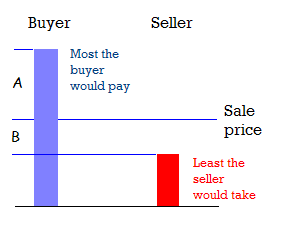 Excuse my poor excuse for an illustration. Hopefully you can see that ‘A’ is the difference between the price of a transaction and the most the buyer would’ve spent, and ‘B’ is the difference between the price and the least the buyer would’ve accepted. So, in this interpretation, the value of the transaction to the buyer is A, then value of the transaction to the seller is B, and the overall value created by the transaction is A + B.
![Reblog this post [with Zemanta]](http://img.zemanta.com/reblog_e.png?x-id=bb752fa5-e3b0-476e-996c-3a89da39ec2d)