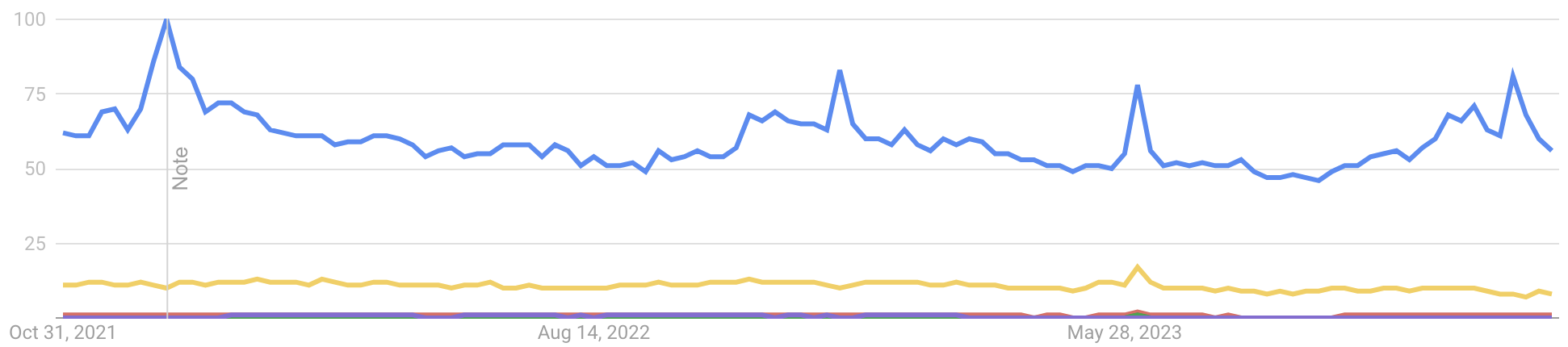
I have been trying to get to grips with the meaning of investment “bubbles” for a couple of years now (for instance in this blog post about tulip mania). I first started to look into this during the local property boom when I was also studying finance. However, there’s increasing talk online of whether we are now in some sort of tech bubble, akin to what happened around the years 1999-2000 and resulted in the dot-com crash.

I wouldn’t say that I have a mature position yet on bubbles, but I think I know enough to say that we’re not in a tech bubble. At least, not yet.

One problem with a test for a bubble is that it is difficult to know for sure that you’re in one until after they’re over. For one sure sign of a bubble is that it ends in a crash – the bubble pops. At this point, prices of the investments in question drop quickly, and many people lose a fortune.

Other signs of a bubble, such as speculative investors (people investing because they expect prices to go up due to investor behavior not necessarily due to increase in underlying worth) or dodgy investments are present in most markets most of the time, and shouldn’t be a concern of themselves. You would hope that in a market there are a variety of positions being taken on investments for a variety of reasons, and that new investments can be introduced into a market if there is a demand for them.

Also, many markets are naturally cyclical, with regular booms following busts over time. Just because a market is hot doesn’t mean it’s in a bubble, although it probably means prices are higher than otherwise warranted, in which case you’re unlikely to pick up a bargain. But people investing for the long-term with diversification across different markets can typically ride-out a cyclical decline.

That said, the first reason I don’t believe we are in a tech bubble is that currently a decline in the value of tech start-ups wouldn’t result in the average punter losing a fortune, because the average punter is not able to invest in tech start-ups. We’re not in a situation, like back in 2000, where an ordinary investor can invest in the latest crazy tech stock on the NASDAQ. It is really VCs and Angels who are taking the risks right now. So, we can’t yet experience the sort of widespread disaster that characterizes a crash.

The other reason I don’t think even the keen anticipation for the Facebook IPO could make this a bubble is that a bubble is a description of a market and not a single investment. You can’t really talk of a 13 Pearl St Essendon bubble or an Enron bubble (even while their stock did crash and wipe many people out). We would need to see average people investing in a variety of new tech companies for there to be a bubble in the tech market.

But there may be signs that this could yet occur. Services like Kickstarter and IndieGoGo have sprung up that allow everyday people to pledge or commit money to a cause, which might be to bring a product or service to market. If causes start to take on more investment characteristics, this begins to look like a means for early stage investment in tech companies.

If I start to hear about people extending the mortgages on their homes to put funds into Kickstarter projects, I will be worried that we’re in a bubble, but I’m not worried yet.

pixelstats trackingpixel

Tags: , , , , , ,

I borrowed this book from a friend in Perth back around Christmas-time last year, lugged it back to Melbourne, and I’ve been reading it on and off since then. I guess this shows it isn’t “un-put-down-able” but it was definitely compelling enough that I came back to it again and again, wanting to finish it. For example, I blogged about one of the many parts I found interesting previously. Having finished it now, I can say it was definitely worth it.

Steve Jobs

Insightful biography, leadership text and history of computing

I read the actual, physical hard-cover form of the book, which in retrospect was ironic since Steve Jobs made available the means to easily read the e-book form of his book on the iPad 2 that I own. The book – at 1125g – weighs-in at about twice that of the iPad 2, and hence I couldn’t easily read it during my usual work commute. This would normally be a severe impediment to reading, but the book was fascinating, insightful and a surprisingly easy read. However, I would recommend the e-book edition for those that have appropriate devices.

I’ve read a few biographies, and this stands-out as the one that I’ve come away from with the greatest sense of understanding the subject. Isaacson is a good researcher and writer and has produced a book that seems to effortlessly roll together a biography, a business leadership text and a history of the computing revolution that came out of Silicon Valley. On the one hand, it was eye-opening how badly Steve Jobs treated people – colleagues, employees, family – but there were many things that I took out as lessons for how technology products evolve and why they succeed.

Yet there is a problem in extracting such lessons from the life of Jobs. As Isaacson has commented elsewhere, Jobs’ “personality was integral to his way of doing business”. There is a similar problem in divorcing the value of his products from his own value system. Either one can accept that his success and his faults are inseparable, Apple Inc could never have been achieved by anyone else, and hence the delightful products are the result of bad treatment of amazing people. Or one can extract out the key lessons of his life, another person could achieve similar greatness in following them without treating others as roughly, similarly inspiring products could be created through other means, and hence Jobs’ treatment of people is inexcusable.

The book also touches on the lives of John Lasseter and Jonathan Ive, who are potentially the prime creative forces at Pixar and Apple, respectively, although somewhat overshadowed by Jobs in their day. Both are creative visionaries and leaders, yet neither seem to possess Jobs’ inter-personal flaws. This suggests that the latter view above is more likely. However, I eagerly await a similarly in-depth biography of Lasseter or Ive.

Rating by andrew: 4.5 stars
****1/2

pixelstats trackingpixel

Tags: , , , ,

This month I’ve already read the book club book. The actual book club get-together is still almost two weeks away, so I’m actually in some danger of forgetting all about it by then. I seem to have a talent for forgetting the details of a book, which can come in handy, since it justifies me keeping a copy of good books on my book-shelf – I know I can enjoy them all over again.

But this book was one that I nominated, so I really should try to remember something about it for the discussion. Hence, I’m going to note my thoughts down here, in easy-to-reference form.

The Immortal Life of Henrietta Lacks

A personal tale masquerading as an ethics tale hidden inside a science tale

When this book was selected for book club, it was partly on the basis that it had over 1,000 reviews on Amazon.com with an average score of 4.5 out of 5. I think this is a fair rating – there is something in this book for everyone.

The author, Rebecca Skloot, takes us through her journey of discovery regarding the family and story behind the “HeLa” line of cells – cells still alive today and involved in important science. Her close connection to the family becomes an important part of the tale, both because it allows her to access the detailed history of the family but also because it provides a very human face for the abstract cells.

The absence of such a human face is part of the context for so many of the ethical issues that occur in the history of the cell line. Examples of racism, exploitation of the poor, the law trailing scientific advances, lack of informed consent, lack of compensation, industry profiting from volunteers, scientific denial, and many others. The book is long-ish and I feel like I should’ve taken notes of these issues so that I could remember them to discuss later.

The tale is at times amazing, horrific, uplifting and sad. For me, one of the saddest aspects was how disadvantaged the family has been. Their ancestors were exploited as part of slavery on a tobacco plantation and they never seem to have escaped the legacy of that. Although, the book itself promises to assist, so perhaps the family will have a happier future than their past.

Rating by andrew: 4.5 stars
****1/2

pixelstats trackingpixel

Tags: , , , , ,

Over time, we have amassed a chaotic collection of plastic containers. I’m sure that’s not unusual, since stuff expands to fill available space, especially if it’s polyethylene.

Due to the sheer number of containers in our plastics cupboard, it became extremely annoying to find a matching container and its lid. (Again, something that’s not usual according to the comic on this site.) We initially tried just buying a container system and sticking that in its own box in the cupboard, but it didn’t take long before it got out of hand, too. Then we struck upon the simple solution of just putting all the lids in one box and this has greatly improved the time to match a container with its lid.

I was going to post a proof of why this makes sense. But, then I figured, generalising  the Internet Rule 34, if someone can think of it, it will be on the Internet. So, I tried to find it. And failed.

Perhaps it’s out there, but the reason I was searching for it was to save myself the time to write up a proof. Eventually too much time had been spent searching that I had neither my own proof nor someone else’s.

However, I did find the following delightful video of someone who is clearly very passionate about organising things, and who espouses the same strategy of putting lids in a separate box.

YouTube Preview Image

So, this post has become really quite pointless. However, I have managed to link to all of Wikipedia, Urban Dictionary and YouTube, so I trust the deities of the Internet will give me a pass this time.

pixelstats trackingpixel

Tags: , , , , ,

I’ve come across many different explanations of “what is a leader”, but the one that seems to make the most sense to me is that a leader absorbs complexity. Where there is chaos, ambiguity, confusion and complexity, the addition of a leader makes things simpler and clearer. People know what they should do.

Unfortunately, I don’t remember where I came across this definition, but I was reminded of it again as I read Walter Isaacson’s biography of Steve Jobs. Most people would agree that Jobs was a leader in his industry and, together with his lead designer Jony Ive, has transformed many consumer electronics products.

Isaacson describes Jobs as aiming for “the simplicity that comes from conquering complexities, not ignoring them.” He also quotes Ive as saying “Simplicity isn’t just a visual style … It involves digging through the depth of the complexity … You have to deeply understand the essence of a product in order to be able to get rid of the parts that are not essential.”

Adding features to a product makes it more complex and often more difficult to use. Another quote from the book has Jobs instructing the programmer of the iDVD application: “It’s got one window. You drag your video into the window. Then you click the button that says ‘Burn.’ That’s it. That’s what we’re going to make.”

As I read these quotes, I was going “Yes!” Leadership and simplification, it became clear to me, were two aspects of the same endeavour.

Additionally, internal reports are the “product” that we deliver to company executives, and can benefit from this sort of product simplification thinking. Providing decision-makers with more options is often unhelpful – the outcome that is best is creating an environment where decisions can be made easily and confidently. However, this shouldn’t be done by merely eliminating options (e.g. just giving the “top” 2 or 3) – this provides a veneer of simplicity rather than conquering the complexities underneath. Providing thought leadership and guidance involves understanding the problem deeply.

Another way I think about strategic analysis is that it is like an “argument” – it concludes with recommendations that follow logically from the data. In this way, a simple and powerful argument can be considered elegant – a concept well known in mathematics. The computer scientist Edsger Dijkstra, commenting on mathematical elegance, said “Elegance is not a dispensable luxury but a factor that decides between success and failure.” This is probably something that Jobs would agree with.

In any case, the definition of leadership that I started with is itself an elegantly simple one: absorbing complexity.

pixelstats trackingpixel

Tags: , , , , , , ,

This is something that blew my mind last week. Some paleontologists are convinced that there were fewer dinosaurs than we thought – that some different types of dinosaurs were just the adult form of another one, despite the fact that they look completely different. It’s explained in this 20 minute TEDx talk:

YouTube Preview Image

To completely spoil the video, Jack Horner (the paleontologist inspiration behind Jurassic Park) believes that:

  • the Dracorex, Stygimoloch and Pachycephalosaurus were the same dinosaur
  • the Triceratops, Nedoceratops and Torosaurus were the same dinosaur
  • the Edmontosaurus and Anatotitan were the same dinosaur
  • the Nanotyrannus and Tyranosaurus were the same dinosaur

and he deduces this through cutting open dinosaur skulls and bones at the Museum of the Rockies where he is the curator. Those skulls/bones of the suspected “younger” dinosaurs are spongy while the “older” ones are more solid. If other museums were happy for scientists to cut open their dinosaurs perhaps this would’ve been discovered sooner.

But perhaps there’s another angle. If women were more involved in the science of paleontology earlier on, perhaps this would’ve been discovered sooner.

Part of the basis for the theory is that no child dinosaurs (ie. small / less-developed specimens) of the now-suspected “older” dinosaurs have been found to date. To my admittedly non-expert mind, this is pretty damning evidence right there. According to Wikipedia, the Torosaur (for example), was first discovered in 1891. Somehow, it has taken over a hundred years for a dinosaur expert to come up with evidence to support the simple theory that the reason there are no child versions found in all this time is that there are no child versions, ie. that it is an adult version.

Horner himself puts forward the explanation that scientists just like to name things – the more dinosaurs, the more chance for names. However, attempting to put on a feminist-shaped hat, I would also think that an alternative explanation is that the predominantly male dinosaur collectors  of the early years of paleontology were not interested in looking for child dinosaurs – the only interesting dinosaurs were the big ones, that probably also turned out to be the male ones. I wouldn’t blame the individual collectors for this – I would think it likely that this was the culture of the industry at the time. Hence, it’s only as the industry changed, and more women came into it for example, that such thinking changed – thinking that enabled a real interest in finding child dinosaurs and explaining what happened to them. (And I realise that I’m falling for a stereotype here that women would be more interested in dinosaur children than men would be, but I suspect it’s true all the same.)

This is merely a hypothesis, and informed merely by personal speculation and a few web searches today. For example, an article from 2010 in Wired trying to identify significant female paleontologists in the face of a complete lack of their public presence. Also, a blog post from a female paleontologist describing how it has traditionally been a male-dominated profession (the photos of Paleontologist Barbie are worth a look, too). In any case, I wonder if there will be further breakthroughs due to the changing gender mix in science.

pixelstats trackingpixel

Tags: , , , , , , ,

This month’s book club had us read a book I first read ages ago, and it was a real pleasure to re-read and find that I still liked it. In fact, I unsuccessfully nominated it as a book club book ages ago (another one of my nominations was selected that month instead), and it was also nice to find that it worked well for book club discussion.

The Daughter of Time

A story about history stories that hopes to right a historical wrong

Josephine Tey – the pen-name of Phys Ed teacher turned author Elizabeth Mackintosh – is apparently know for her not-to-formula mystery writing. This is the case here, where the detective has to solve the mystery while stuck in a hospital bed, and the mystery dates back 500 years. However, the bed-bound-detective is not the only quirky character, with a cast of contemporary and historical figures parading through the story. Together with the joyous writing itself, I found the book a treat to read.

One down-side is that it was written for an English school-system educated audience from the 1950s, and assumes that you have a fair grasp of royal lineage and history. If you consider War of the Roses to have been an average movie, then you may need (like I) to just let the references to multiple Edwards, Edmunds and Elizabeths just flow past and be confident that it will all come together in the end.

While the book tries to overturn the popular account of one of history’s most infamous kings, it also takes some jabs at history in general. The author clearly has felt frustrated by both historical accounts and historical fiction, as well as the annoying tendency for a good story to survive better than the facts.

Rating by andrew: 4.0 stars
****

pixelstats trackingpixel

Tags: , , , ,

We’re about to have both our kids in child-care, for at least some of the week. This means they’re joining around a million other kids across Australia using the child-care system, according to the government. For various reasons, all of the families represented by that statistic are using professional child-care instead of completely looking after their kids themselves.

Professional child-care isn’t free, of course, so it is open to only those families who can afford it. Specifically, they need to be able to afford the child-care even after accounting for the additional income that might be brought in through allowing a care-giver such as a parent to enter the paid workforce. I wondered exactly how much income would need to be brought in to offset the paid care, so I’ve thrown together a quick spreadsheet on the economics of child-care.

To put two children into care, five days a week, for all but four weeks of the year, at a child-care centre that charges $87/day, the now-employed parent would need to earn at least $30,970.06 full-time to offset the costs. At a centre charging a higher rate of $120/day (but less than a reported maximum of $135/day), the salary would be $52,773.72. If there were three kids, then the salary would need to be $84,308.94.

Instead of looking at this as the amount that would need to be earned to go into the workforce, it can also be viewed as the amount that is being effectively earned by not going into the workforce. A stay-at-home parent is “worth” at least a salary of $30,970.06 from that perspective. I recognise that other costs avoided or reduced could also be included, reflecting domestic chores also performed by the stay-at-home parent, from cleaning to cooking, however these might also be shared with others depending on the household situation, so I will leave them out of my simple analysis.

To put this in context, $30,970.06 per year is $595.58 per week, and the Australian minimum wage is $589.30 per week. Taking a minimum wage job to put two kids into child-care doesn’t make much sense if you just look at the numbers. On the other hand, according to the ABS, the average full-time adult earns $1,322.60 per week (or $68,775.20 per year), and if we look at women only, it’s $1,165.00 per week ($60,580 per year). So, assuming the stay-at-home parent can leave home for an average wage, it is probably economically positive.

Knowing this is one thing, but it doesn’t do anything for the twin challenges of finding child-care places and finding a decent paying job.

pixelstats trackingpixel

Tags: , , , , , , ,

I came across a post recommending this book on the go-to site for geeky current affairs – Hacker News. Unusually for me, I ordered it on the strength of that.

REWORK

A new employee guide at 37 Signals

This is the type of book that can probably be read in 1/2 hr, but I read it in stops and starts on the train to/from work. It’s a collection of 1 or 2 page write-ups on business topics, distilling the wisdom of Jason Fried and David Hansson from web productivity company 37 Signals.

While it aims to offer practical advice on how to work more effectively, I found that most of the advice didn’t make sense in the context of my job, and I now struggle to remember any of the advice a couple of months after having read it. It has resulted in no improvement to my work routine, despite my initial interest in the promise from the front cover to “change the way you work forever.”

On the other hand, I could see how it might be useful to a reader who is running or would like to run a small business (e.g. two themes are competitors and damage control). However, I can also see how it would be most useful to Fried and Hansson in normalising their preferred work culture within their own business. I would not be surprised if every new employee was given a copy of this book on their first day at 37 Signals.

Rating by andrew: 2.5 stars
**1/2

pixelstats trackingpixel

Tags: , , ,

It was during hellish holiday, I was sleep-deprived, and yet there I was in a book store and there’s a certain comfort that comes from having a new book to read. On a “recommended by staff” shelf I found an interesting looking title with terms like “international bestselling”, “dazzling”, “gripping” and “genius” on the cover. I cheerfully left the book store with the book in tow.

It was perhaps the most disappointing book I’ve ever read.

The New York Trilogy

Absurdist and boring

I am not a stranger to the mystery/detective genre, having read most Agatha Christie novels, all of Sherlock Holmes, and in terms of more modern fare, even some Peter Temple and Stieg Larsson. However, while Paul Auster tells three different stories in this collection with a detective protagonist, I admit that none are like any I’ve read before.

I was primed to enjoy them, and I did even for a few pages, but as the pages turned into chapters, I found myself finding more and more excuses to put it down, and then only with reluctance picking it up again. While I didn’t like any of the main characters, I was willing to stick it out, because it held the promise of being good. Perhaps it was only when I reached the end that I’d discover why it was meant to be a work of genius?

Perhaps it was too genius for me. Although, if you’re the sort of person that enjoys stories where different characters have the same name, the author’s name is used in the story, or characters are named in a theme, then this is probably your sort of genius. It was clear that it was meant to be clever, but for me it never translated into enjoyable.

Finally, I felt a bit like one of the characters from the book myself, and wanting to destroy the pages so that no-one else would ever have to read them. I think I’ll just drop it into a charity bin instead. Someone else may want to use it to prop open a door, or something.

Rating by andrew: 1.5 stars
*1/2

pixelstats trackingpixel

Tags: , , ,

Next Page »